TRADITIONAL AND REVOLUTIONARY
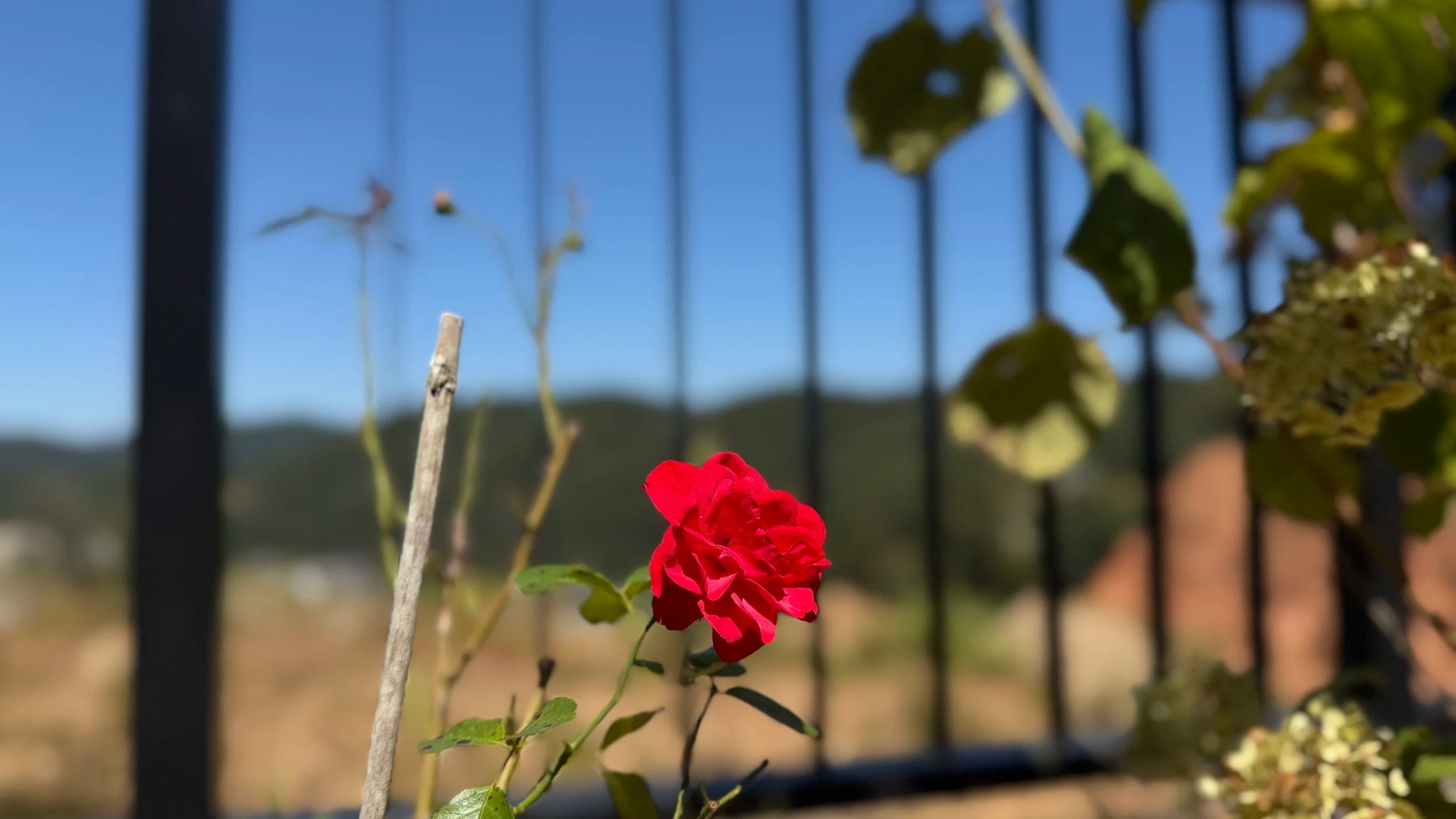
Rose blooming, traditional. Rose blooming in September, revolutionary Both are wonders.
“The biggest paradox about the Church is that she is at the same time essentially traditional and essentially revolutionary.” Thomas Merton
The word evangelical, as in I am an evangelical Christian, has dropped out of my vocabulary for quite a while now. While it remains my spiritual heritage and I appreciate its gifts over the years, my Christian journey expanded to that of an ecumenical Christian. The School of Spiritual Direction I graduated from is rooted in an ecumenical tradition, which was a big draw for me. The Taizé community my wife and I visited ten years ago and fell in love with has been a model, global icon of ecumenical Christian brotherhood and community. Thus, even before I joined the school, I was well on my way to embracing the wider, more traditional, generous Christian traditions. One of the main culprits- I mean, guru- has been Thomas Merton.
Whatever the tradition we belong to, I am passionately attracted to and subscribe to the paradox Merton penned above—essentially traditional and revolutionary at the same time. You lose one. You lose everything. Clearly, Jesus was traditional and revolutionary at the same time.
Human traditions and revolutions revolve around trying to “save ourselves,” ironically, by attacking, harming, and even killing others who stand in our way. The true Church traditions and revolutions at their heart are about dying to self. True revolution arises out of suffering and death from the ground up, not by toppling the top.
When reading Kenneth Scott Latourette’s volumes of A History of Christianity along with other macro-Church historians, one can discern an undeniable, repeatable cycle in human and religious history: decay, death, renewal, expansion, and flourishing. And repeat. After each flourishing, decay invariably sets in over time. Death must happen for renewal to take place, followed by expansion. Thus, the stage between decay and death remains critical for any hope for renewal. On a side note, living in a four-season country now, I appreciate and witness the cycle from decay to death to renewal to expansion to flourishing right before my eyes. Decay, as in fall foliage and deciduous trees, reminds us that decay is a natural cycle of life. History repeats itself again and again, with traditions desperately trying to hold on (which is another irony: traditions would not be traditions without keeping them); unable to accept their own decaying status, death becomes the last unwilling resort.
Revolutions come by way of death since that is the only passage to renewal, expansion, and flourishing. “Listen carefully: Unless a grain of wheat is buried in the ground, dead to the world, it is never any more than a grain of wheat. But if it is buried, it sprouts and reproduces itself many times over. In the same way, anyone who holds on to life just as it is destroys that life. But if you let it go, reckless in your love, you’ll have it forever, real and eternal.” (John 12:24, The Message) In fact, this very verse spoke to me as I embraced “death” on a personal level. So I would project that the historical pattern mentioned above applies to each of our lives at a microscopic level.
During the height of the pandemic, which coincided with my one-year sabbatical, I experienced “death.” Out of death came a more foundational, thorough deconstruction of my faith, followed by newfound desires, rising from the ashes. Additionally, I experienced, to use the words above, renewal and, carefully, flourishing. As much as I was kicking and screaming to embrace death because I did not want to die, I eventually did, aided by the silence and solitude of the pandemic. (The timely aid of silence and solitude is another big topic. It is hard to die when one is too busy, noisy, important, and/or preoccupied with self.) Little did I expect that a spring of renewal would come. I knew in my head that if a grain of wheat is buried, it will sprout and reproduce itself, but I had not experienced anything close to Jesus' words until then.
---------
From my seat, I see revolutions needed at multiple levels of human societies. However, I would not be watching for headline-grabbing news about what systems and/or people are doing to bring about change from the top, but would be praying for unheralded, courageous death and listening from the ground up. Speaking of authentic traditions, if there is one tradition above all, it is the tradition of dying and dying well.
The word essentially Merton described above, rings true. All true revolutions in the past and the future share their common root in Jesus and how he brought about the only revolution we care about. N.T. Wright’s The Day the Revolution Began: Reconsidering the Meaning of Jesus’s Crucifixion sums up the ongoing impact of the revolution. I stand with Merton when he wrote: “[This] is the most complete revolution that has ever been preached; in fact, it is the only true revolution, because all the others demand the extermination of somebody else, but this one means the death of the man who, for all practical purposes, you have to come to think of as your own self.”
One side caveat to tradition and revolution is that revolution cannot happen without knowing the tradition well. Only those who know the tradition well can break the tradition and have the right to “start” the revolution. Jesus, knowing the tradition well and from the inside out, incited the unthinkable—bringing about one true revolution that matters and timelessly models by “letting it go and being reckless in his love.”
Furthermore, Wright writes about how this revolution works: “Jesus died for our sins not so that we could sort out abstract ideas, but so that we, having been put right, could become part of God’s plan to put his whole world right. That is how the revolution works.”
So, what say we?
Jesus was essentially traditional and ultimately revolutionary.